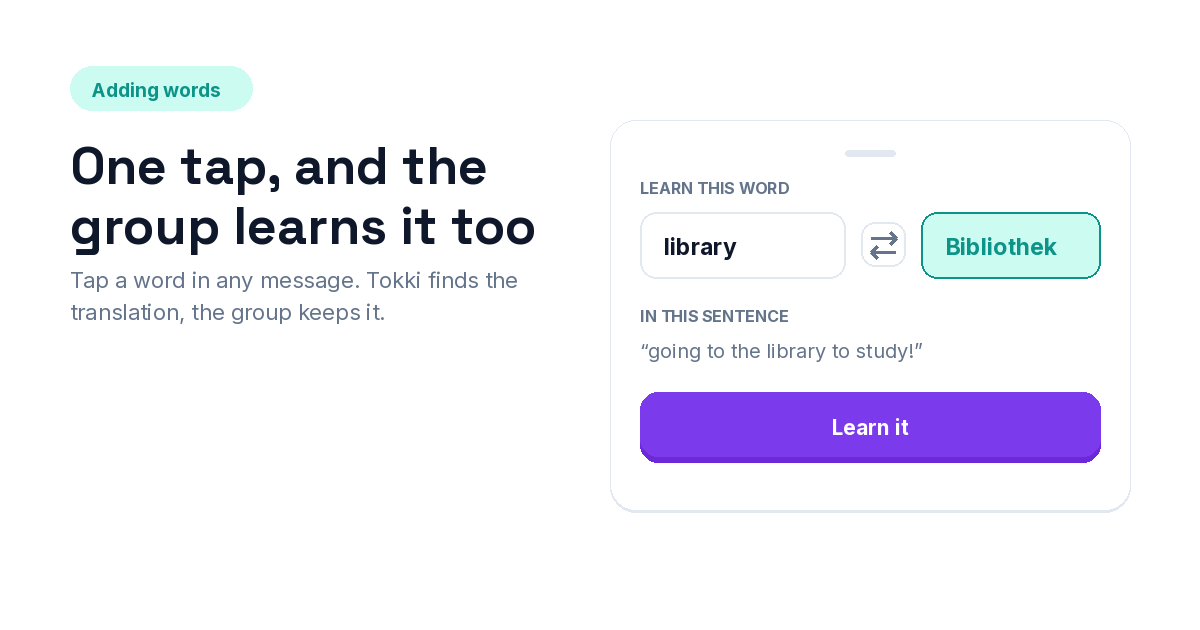
The moment you meet a new word is the moment you are most likely to keep it — you have the sentence, the context and a reason to care. Almost every app makes you leave that moment to save the word. Tokki does it in one tap, without leaving the message.
Saving a word should not be a chore
The usual route: see a word, open a dictionary, copy it, open a flashcard app, create a card, write the translation, go back. Six steps and a context switch to keep one word — so most people keep none, and the word is gone by evening.
In Tokki, you tap the word inside the message. That is the whole interaction. The translation is looked up while you decide, and you confirm.
Phrases, not just words
Tap one word, then tap another, and everything in between comes along. That matters more than it sounds: what you actually want to keep is often "on the other hand", "no dia seguinte", "sich freuen auf" — units that mean nothing word by word.
Which language is this, anyway?
A detail that cost us a real bug: in a group learning German, a Portuguese speaker taps an English word. Which side of the pair is it? We used to guess, and got it backwards often enough that people ended up with reversed entries — and then the app replaced Portuguese with Portuguese.
Now the direction is explicit, and there is a flip button right there. The first guess comes from the group's own vocabulary, then from language detection, but you always see it before saving.
The word goes to the group
This is the part that makes it stick. A word you save is not filed in a private list: it joins the vocabulary of that chat, and from then on it is swapped into everyone's messages. Your friend uses it tomorrow without knowing you added it. You see it again in a sentence someone else wrote, which is spaced repetition arranged by other people.
If you are not the one who runs the group — a student in a class, for instance — you can suggest the word instead, and whoever runs it decides.
When one translation is not enough
"Time" is Zeit, Mal and Uhrzeit. "Tempo" is time and weather. Any vocabulary list that stores one translation per word is lying a little, and the lie shows up exactly when the word appears in a sentence where the stored translation does not fit.
So a word can carry several translations, and when a message uses one, you can tap it and pick the one that fits that sentence. Your pick counts as a vote, and the group converges on the right reading for each context. Whoever runs the group can settle one for good.
You can also keep what a dictionary would: gender, plural, past tense, participle, example sentences. Not required, but there when the word needs it.
Words you were going to need anyway
Every so often Tokki suggests words from your own recent messages — the ones you keep typing in your language, which are by definition the ones you will need again. It is a better personal frequency list than any course's first hundred words, because it is built from what you actually talk about.
Try it on your next message
Open a chat, find a word you would like to own, and tap it. If it sticks, you will notice the same way everyone does: not by studying, but by reading a message a week later and understanding it without stopping.