Most of what a language class does between lessons is chase people: did they do the exercise, did they practise, did anyone open the book. Tokki moves that part into the group chat your students already have open, and marks it for you.
The problem with homework nobody can see
You set an exercise on Monday. On Thursday you find out that four students did it, two did it wrong in the same way, and the rest will do it in the ten minutes before class. None of that was visible while it was happening, which is exactly when it would have been useful.
The gap is not motivation. It is that practice lives somewhere nobody looks: a workbook, a platform with its own login, a PDF in an email. Meanwhile the group chat gets opened forty times a day.
Start with the group, not the course
In Tokki, a class is a group chat with a shared vocabulary. You create the group, share the invite code, and students are in — no accounts to provision, no seat licences, no course to build first.
From there, every word the class is learning is swapped into the messages people send each other. A student writing "I'm going to the library" sees the German word in their own sentence, and so does everyone else in the group. The practice is the conversation.
Activities: four kinds, one place
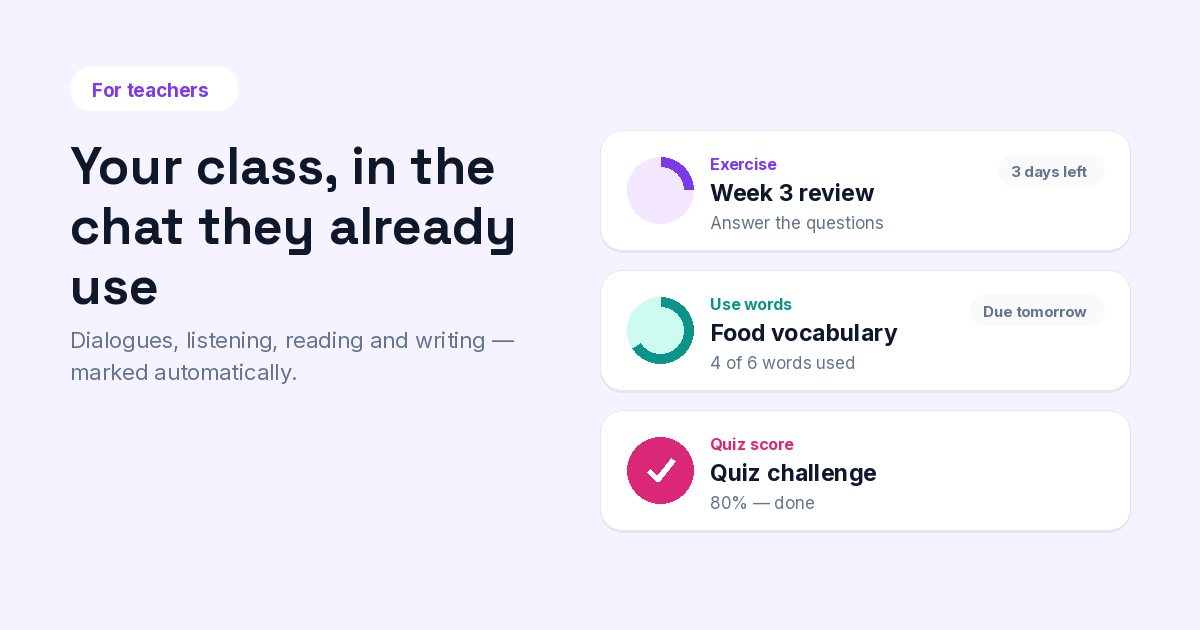
An activity is a goal plus something the app can already see. Nothing is marked "done" by hand.
- Exercise. Questions you write — listening, reading, writing.
- Use words. Pick words from the class vocabulary; the goal is met when students actually use them in the chat.
- Quiz score. Reach a score in the vocabulary quiz built from your class's own words.
- Practise daily. Be active on a number of different days — the one that fights the Sunday-night cram.
Dialogues, and the questions that hang off them
Write a conversation once:
A: Good morning! What would you like to drink?
B: A large coffee with milk, please.
Tokki reads it aloud, so your students get listening practice without you recording anything. Then you attach as many questions to that dialogue as you want, and they do not all have to be listening questions: a multiple choice about what B ordered, a gap to fill with croissant, a scrambled sentence to put back in order, an open answer where they write their own café conversation.
When you review the attempts, the answers are grouped under the dialogue they belong to, instead of scattered through a list.
What gets marked for you
Multiple choice, matching pairs, reordering, gap-fill, dictation and listening comprehension are all marked automatically, including alternative accepted answers — "took" and "caught" can both be right for the same gap. You can require capital letters where they carry meaning, which matters if you teach German.
Open answers are the deliberate exception. Those come to you, with everything else already scored, so the only thing on your desk is the part that needs a teacher.
Seeing who practised, not who logged in
Progress comes from what students did: words used in conversation, quizzes taken, questions answered, days active. Open an activity and you see each member's progress on it. It is a short list and it is honest, because nobody can tick a box to appear on it.
A first week that works
- Create the group and share the invite code. Pick the language the group is learning.
- Add ten words you are teaching this week. Type them in the activity sheet — they do not have to exist anywhere first.
- Set one "use words" activity with a one-week deadline. This alone changes the chat: students start reaching for the words.
- Add one exercise with a dialogue and four questions. Fifteen minutes of your time, and it marks itself.
- Check the progress list on Thursday, not Sunday. You will know who to nudge while there is still time.
Where it does not fit
Tokki is not a course. It has no syllabus, no placement test, no grammar explanations. If you need a textbook replacement, this is not it. What it does is the part around the lesson: vocabulary that follows students into their own conversations, practice you can see, and marking you do not have to do.
We are running a free pilot with a small number of teachers and schools — we set the group up with you, import your vocabulary, and build your first week of activities. If that sounds useful, write to us.